


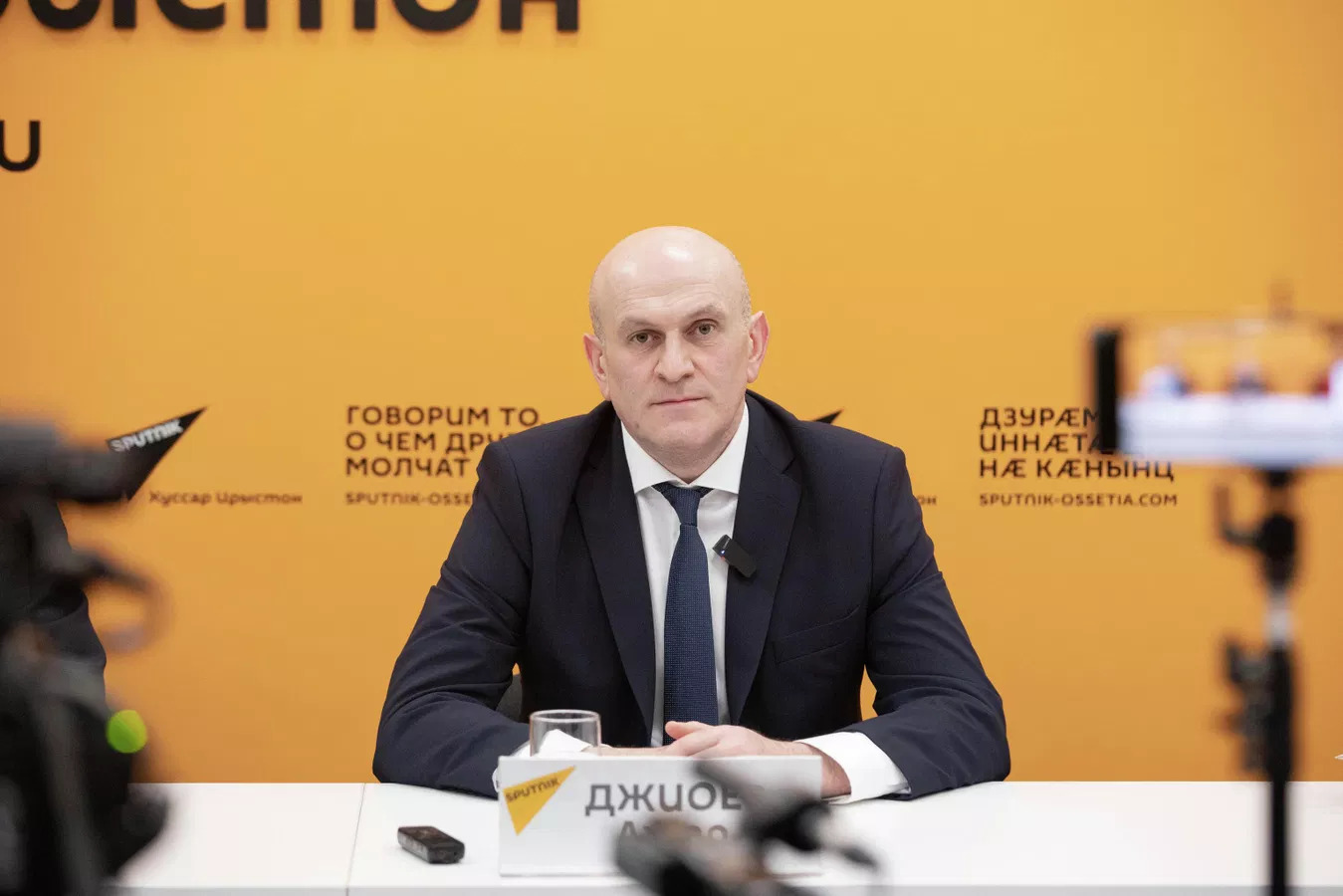
From November 2 to 3, as part of the implementation of the Plan of Consultations between the foreign policy agencies of South Ossetia and Russia, a series of meetings were held in Moscow between the Minister of Foreign Affairs of the Republic of South Ossetia, Akhsar Dzhioev, and representatives of the Russian Ministry of Foreign Affairs — with the leadership of the 2nd Department of CIS Countries, the Latin American Department, as well as the Department of the Middle East and North Africa and the 4th Department of CIS Countries. The minister spoke to Sputnik about the consultations that had taken place, the upcoming round of international discussions on security in the South Caucasus, and relations with Syria, Nicaragua, Venezuela, and Transnistria.
The format of consultations in Moscow
The meetings in Moscow were held within the framework of the two‑year Consultations Plan between the Ministries of Foreign Affairs of South Ossetia and Russia, signed in October 2025, as well as in light of the instructions given by the President of South Ossetia, Marat Kambolov.
“On November 2–3, we held regular consultations on the issues and with the departments that deal with the countries of Latin America and the Middle East, as well as those related to the Belarusian direction, the Transnistrian direction, and also with the leadership of the Fourth Department of the CIS, which is directly involved in South Ossetia, Abkhazia, and works on the Transcaucasus as a whole. This also includes their involvement in international discussions on security in the Transcaucasus and in the Geneva discussions,” the Minister shared.
The current plan of consultations between the Ministries of Foreign Affairs of South Ossetia and Russia was signed in October of last year; upon the expiration of the term, it is intended to renew it, refine it if necessary, and include new aspects. Dzhioev thanked the Head of the Russian Foreign Ministry, Sergey Lavrov, and his Russian colleagues from the Russian Foreign Ministry for their constructive approach.
Another annual format of relations between the two ministries is professional development courses for diplomats, which are held at the Diplomatic Academy of MGIMO (U) of the Russian Foreign Ministry – the latest cycle of courses is ending in just a few days, Dzhioev shared. According to him, the republic’s Foreign Ministry is trying to “involve other departments in this process” so that their employees can also take advantage of this opportunity.
The Geneva international discussions on security in the South Caucasus
Dzhioev described the Geneva format as the only international platform where South Ossetia can convey its position to the international community. There are two main areas of focus: security and the humanitarian component. The key issue remains security – the development, coordination, and approval of a legally binding document on the non‑use of force between South Ossetia and Abkhazia on one side and Georgia on the other. The next, 68th round of discussions will take place in the first half of November.
“Unfortunately, we have not yet received any understanding from our legal opponents, but nevertheless, our delegation will be actively working in this direction.” And I hope that in the end we will arrive at some positive outcome for us. It is obvious that without resolving security issues, we will not be able to make any progress on other aspects (within the framework of the negotiation process – ed.), since everything comes down to security,” Dzhioev emphasized.
For several rounds now, Russian colleagues have been raising the issue of moving the venue for international discussions away from Geneva, since Switzerland, while positioning itself as a neutral country, “in fact, has significantly moved away from these positions,” Dzhioev says.
“The point is that Switzerland has joined and periodically supports the unlawful sanctions that the European Union and the collective West as a whole impose on Russia. And, naturally, this cannot but concern us as well, since the platform where negotiations take place should, as we understand it, be more or less neutral,” the minister notes.
Moreover, in September 2026, Switzerland held a referendum on an initiative regarding what is known as “strict neutrality” – if approved by the country’s population, neutrality would be enshrined in the constitution and would include a ban on supporting any sanctions except those of the UN Security Council, as well as a ban on military cooperation with other countries or organizations. The initiative was rejected by 70% of voters. According to Dzhioev, this once again confirms that Switzerland has moved away from the “traditional principles of neutrality.”
The Fourth Department and Russia’s position
Several meetings were held at the Russian Ministry of Foreign Affairs, one of which was with the leadership of the 4th Department of the CIS, which works in the Caucasus direction and has a wide range of tasks related to Armenia, Azerbaijan, Georgia, Abkhazia, and South Ossetia.
“And, naturally, our Russian partners are interested in ensuring that peace, stability, and security in the region, in particular in South Ossetia, continue to be maintained. As for Russia’s official position, it has been and remains unchanged.” “This has been emphasized repeatedly at various levels, including at the highest level – the decisions made by the Russian leadership in August 2008 remain unchanged,” Dzhioev emphasized.
The Middle East and Syria
The Middle East region, where South Ossetia has warm relations and mutual recognition with the Syrian Arab Republic, is also unstable today – this concerns the conflict between Iran and the United States, Israel’s relations with Arab countries, Lebanon, and Syria itself.
“With the support of our Russian colleagues, we receive objective and up‑to‑date information about the situation in the region. We also try to communicate with our Syrian colleagues. Just recently, I spoke with Syrian diplomats who are now heading Syria’s diplomatic mission in Moscow. Contact is maintained,” the minister emphasized.
According to Dzhioev, despite the overall instability in the region, the Syrian authorities are inclined to preserve the political decisions of the “previous government”.
“Naturally, this is also not easy for them, since, let’s not hide it, Europe is putting pressure on them, but for now the situation remains at the status that was established in 2018, when Syria recognized South Ossetia’s independence. And we will also try to maintain this status,” Dzhioev added.
Latin America
Relations with Latin American partners — Nicaragua and Venezuela — were discussed separately. Thus, Dzhioev described relations with Nicaragua as very good: Nicaragua openly expresses support for South Ossetia and was the second country after Russia to recognize the republic’s independence in 2008.
“Despite the great distances and the difficulties in communication and direct presence in the region, contacts remain at a very high level. And the recent meeting with Ambassador Alba Torres has confirmed this once again. For us, for South Ossetia, the desire to develop relations with Nicaragua remains unchanged...” We understand that this is another continent, and we are trying to use Moscow as a kind of logistics hub where the paths of our friends, including Nicaraguans, and their delegations, cross,” the minister said.
As for Venezuela, the situation in the country today is difficult, but contacts between Caracas and Tskhinval remain.
“As an example, I can mention the presence of the Ambassador of Venezuela to Russia and South Ossetia, Jesús Salazar Velásquez, at the inauguration on September 30 in Tskhinval.” Actually, I can also emphasize the presence of the Minister of Foreign Affairs of Nicaragua at the inauguration. We understand that the transitional period in Venezuela will take some time, and, as we understand it, presidential elections are ahead, but nevertheless, this country remains very important to us. We have the desire and the intention to both maintain and develop these relations,” the minister says.
Transnistria and Belarus
The second department of the CIS, whose leadership Dzhioev also met with, deals with Belarus, Ukraine, Moldova, and Transnistria. For South Ossetia, the Transnistrian Moldavian Republic is of greatest interest in this region; good relations with it have been established since the early 1990s. Logistics are limited: Transnistria borders Ukraine and Moldova, and the Moldovan authorities are creating serious obstacles for Russian diplomats, which constitutes a violation of the Vienna Convention on Diplomatic Relations, the minister emphasized.
“Transnistria is also facing another electoral cycle in the near future.” Presidential elections will be held there. The current president, Krasnoselsky, has served two terms, and according to the Constitution of Transnistria, that is the limit. Therefore, according to our information, Krasnoselsky will not run for a new term. There are other candidates there now who are entering the electoral cycle, and we hope that everything will take place within the framework of the law on elections in Transnistria and, in general, the Constitution of the PMR,” Dzhioev shared.
According to the minister, Belarus is also an “interesting direction,” and he noted that it is necessary to “understand and respect the opinion of Belarusian colleagues” in terms of the level of communication.
“Unfortunately, for now we cannot talk about political contacts, but there are other areas of cooperation, and they will continue. There are certain contacts within the framework of the Union State. A meeting in the format of the Parliamentary Assembly of Russia and Belarus is expected in the near future. And here it is important to note that our parliament has been a permanent observer in this format since October 2008,” Dzhioev said.
South Ossetia will continue to develop cultural, humanitarian, and sports contacts with Belarus, both within the framework of the Union State and separately. Such areas are no less important than political ones, the minister emphasizes, since “much can be conveyed to partners through culture, sports, and other humanitarian areas.”
The primary tasks of the Ministry of Foreign Affairs
Dzhioev described the Ministry of Foreign Affairs, like any political agency, as conservative – its main tasks and approaches do not change; only the methods of their implementation may change and be adjusted.
“Our main task is to ensure external peaceful conditions, to develop South Ossetia, and to facilitate contacts of various kinds: economic, cultural, sports, and mass media. We are ready to assist and provide support for this. Therefore, the main task does not change. Only the forms and methods change,” he emphasized.
The Ministry of Foreign Affairs of South Ossetia, as a conservative agency, will “implement this conservatism taking into account new technologies, new approaches, and new aspects dictated by our modern life,” the minister concluded.