


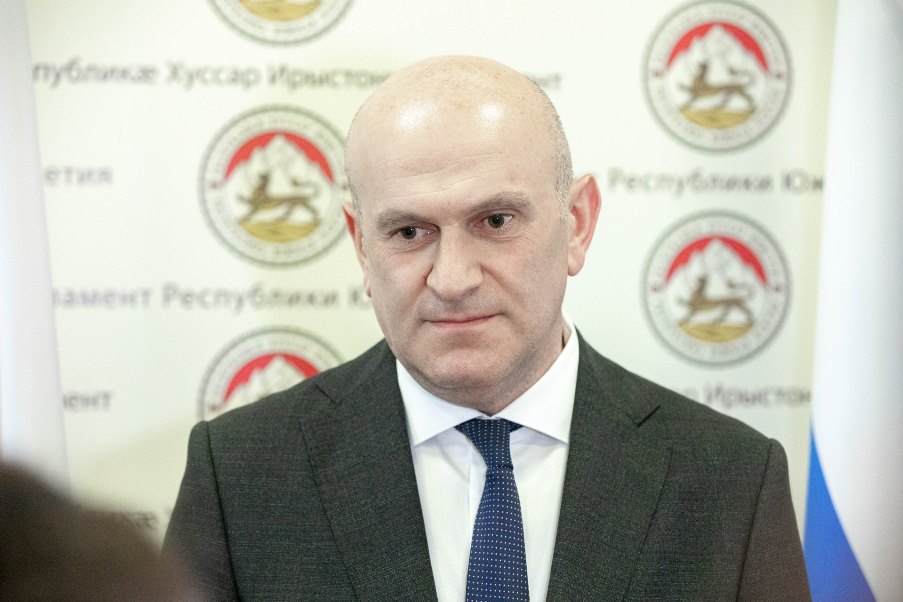
South Ossetian Foreign Minister Akhsar Dzhioev told RIA Novosti in an interview that deepening integration with Russia is the unconditional priority of the republic's foreign policy. At the same time, the prospects for a truce with Georgia, which continues its course towards integration with NATO and European structures, remain in question from the standpoint of Tskhinval's national security.
– Akhsar Muratovich, you are scheduled to meet Russian Foreign Minister Sergey Viktorovich Lavrov on 1 October. What is the purpose of your visit to Moscow? What outcomes do you expect from the talks?
– For us, every dialogue with Sergey Viktorovich is a landmark event, for which we prepare in the most constructive frame of mind. The foreign ministries of South Ossetia and Russia are in constant and close contact, and annual meetings between their heads have already become a good tradition and an effective instrument. They make it possible not only to work out common approaches on key regional issues, but also to synchronise our actions in a broader context.
A particular impetus to our interaction was given by the consultation plan for 2026–2027, which we signed last autumn. In essence, it is a full-fledged roadmap covering every area of interagency cooperation.
In this connection, the forthcoming meeting is, of course, an opportunity to compare notes. We will discuss in detail the progress of integration processes and the status of current agreements. I am confident that the conversation will be substantive, and that its outcome will be concrete steps to further strengthen the allied relations between the Republic of South Ossetia and the Russian Federation.
– What is the legal framework of relations between Russia and South Ossetia built on?
– Today the legal framework of relations between South Ossetia and Russia rests on more than 150 bilateral documents, and their effective and systematic implementation will substantially improve our position in every sphere. That is precisely what the programme of South Ossetian President Marat Kambolov is aimed at.
– The Russian Embassy in South Ossetia recently said that the overwhelming majority of residents of the republic would receive Russian passports as early as next year. How do you assess this factor?
– When the overwhelming majority of residents of the republic hold Russian citizenship, it merely confirms the fact that we are de facto already part of the Russian world. As for the legal forms of our coexistence, they can be settled in close interaction with the leadership of the Russian Federation, proceeding from the interests of our peoples.
– How is South Ossetia advancing on the foreign policy track today, given the difficult geopolitical environment?
– The geopolitical situation in the world is, of course, complex. We live in an era of global transformation, in which the familiar rules of the game are changing, and this makes it necessary to act as pragmatically and consistently as possible.
Our main foreign policy priority remains unchanged – strategic alliance and integration with the Russian Federation. This is the foundation of our security and our statehood.
– Which countries are the most advantageous for the republic to cooperate with?
– If we are talking about countries that are fundamentally advantageous, we focus on those partners that share the principles of sovereignty and respect for international law and are ready for dialogue on an equal footing.
– Does South Ossetia expect recognition from all countries? Is recognition of the republic possible in the foreseeable future?
– On the question of recognition, we are realists. We work to ensure that we are heard, that our voice is heard on international platforms and that the circle of our friends expands. As for recognition in the foreseeable future, anything is possible. The world is becoming more fragmented, and many countries are beginning to revisit their approaches to foreign policy, moving away from Western templates.
– Are there any fundamentally new countries on the list with which you would like to develop cooperation?
– With the support of our Russian colleagues, we are actively working to expand the geography of our contacts, placing emphasis, among other things, on cultural exchange and humanitarian cooperation. We are not isolated; we are integrated into the space of our allies and open to all who are ready to build relations on the principles of mutual respect.
– With which countries is the development of trade and economic cooperation possible above all?
– Here it is important to proceed from current geopolitical realities and our strategic interests. I repeat that the unconditional priority is to deepen integration with the Russian Federation, and in particular to attract Russian investment into the real sector of the republic's economy. But for this cooperation to become real rather than declaratory, we need to simplify logistics chains, with an emphasis on developing transport infrastructure, and to shape a clear investment profile for the republic, so that potential partners can see specific niches in which they can work to the benefit of our economy.
– How possible do you consider a truce between South Ossetia and Georgia?
– The question of a truce with Georgia – or, more precisely, of preserving peace and stability – is not a theoretical one for us; it is a matter of our national security and of historical justice. Since August 2008, thanks to the efforts of the Russian Federation, security discussions in Transcaucasia (IDST) have been held within the framework of the Medvedev–Sarkozy agreements. The key aspect for us in the negotiations is reaching agreements on Georgia's non-use of force against South Ossetia and Abkhazia. The talks are difficult, since the Georgian side is taking no practical steps in this direction and is avoiding a full-fledged political settlement in the context of the existing realities on the ground. For us this is highly important.
– Is there a prospect for the development of diplomatic relations between the countries?
– As for the prospects for developing diplomatic relations, it must be understood here that until official Tbilisi recognises the Republic of South Ossetia as an independent state, this is impossible. Indeed, as long as the policy of non-recognition and the rhetoric about "occupied territories" continue in Georgia at the state level, it is premature to speak of full-fledged diplomatic relations.
– What is preventing a truce between South Ossetia and Georgia today?
– The main obstacle here, as already noted, is the Georgian side's lack of political will to sign a legally binding document on the non-use of force against South Ossetia. For years we have been hearing declarations, but we see no legal guarantees. Georgia continues its course towards integration with NATO and European structures. This is written directly into the Georgian constitution. For South Ossetia, this constitutes a threat to its security. Moreover, Tbilisi is still not ready to acknowledge responsibility for the genocide of the Ossetian people and for the consequences of the 2008 aggression. Without recognition of these facts and without legal security guarantees, trust is impossible.
– Could other countries break off diplomatic relations with South Ossetia, following the example of Nauru, which, according to a statement by the republic's Ministry of Foreign Affairs, was subjected to pressure from the Georgian authorities?
– The situation with the Republic of Nauru, which at the time faced unprecedented pressure over its recognition of South Ossetia's independence, is not merely an isolated case. It is a graphic illustration of how contemporary geopolitics uses economic and political levers to overturn the sovereign decisions of small states.
– Could the Georgian authorities, in that case, resort to provocations and put pressure on other states?
– As for possible provocations, time will tell. It is worth noting, however, that the countries which, despite threats, maintain diplomatic relations with South Ossetia, demonstrate a high degree of political subjectivity. For Tskhinval, this means that each such partner is not merely a tick on the list of countries that have recognised us, but a reliable ally that has stood the test of strength.
– Returning to foreign policy, how do you see the development of relations between South Ossetia and Syria in the context of today's events?
– The question of our relations with the Syrian Arab Republic requires a measured approach. We fully understand that the geopolitical situation in the world is dynamic and that the foreign policy priorities of states may change under the influence of global processes. We understand that Damascus is currently addressing large-scale tasks of rebuilding the country and strengthening its positions on the international stage. We are ready for a flexible format of dialogue. What matters most to us is to maintain open channels of communication and to develop those areas that benefit people.
As the saying goes, diplomacy is the art of the possible. We are not forcing events, but neither are we renouncing what has been achieved. I believe that, with mutual respect, we will find a model of interaction that will serve the interests of both South Ossetia and Syria in the new realities.
https://ria.ru/20261001/dzhioev-2121376096.html